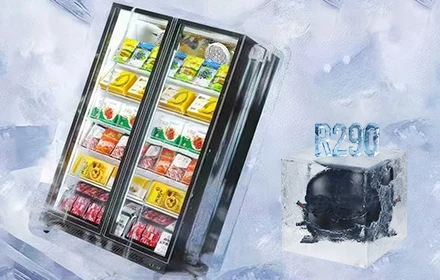
Why Open Multideck Placement Matters More Than You Think
Open multideck chillers (air curtain merchandisers) are designed for high impulse sales and fast product access, but they are also extremely sensitive to environmental interference.
Unlike glass-door units, they rely on a stable air curtain to maintain temperature. Once that curtain is disrupted, you immediately get:
- Warm product zones
- Excess energy consumption
- Condensation and fog
- Food safety risks
This is why placement is not a design detail — it’s a performance-critical decision.
How the Air Curtain Actually Works (And Why It Fails)
An open multideck creates a vertical laminar airflow barrier:
- Cold air is discharged from the top
- It flows downward in a controlled curtain
- It is recaptured at the bottom return grille
This system only works when:
- Airflow is undisturbed
- Ambient air is stable
- No external drafts interfere
Once external airflow breaks this curtain → warm air infiltration begins immediately.
The #1 Rule: Identify “Air Disturbance Zones”
Before placing any open merchandiser, map your store for air disturbance sources:
- HVAC vents (supply & return)
- Entrance doors
- Ceiling fans
- Cross-aisle airflow
- Heat-generating equipment
If airflow is unstable → open multidecks will fail regardless of product quality
Absolute “Do NOT Place Here” Zones
1. Directly Facing Store Entrances
Why this fails:
- Outdoor air constantly enters (hot, humid, or cold)
- Pressure differences create turbulent airflow
- Air curtain collapses intermittently
Results:
- Severe condensation on shelves
- Temperature instability
- Product spoilage risk
Rule: Minimum 5–8 meters away from main entrances
2. Under HVAC Supply Vents (Top Blowing Air)
Why this fails:
- Downward air from vents directly cuts through the air curtain
- Creates mixing of warm and cold air
Results:
- Warm spots (especially middle shelves)
- Compressor overwork
- Uneven product temperature
Rule: Never place directly under supply diffusers
3. Near Ceiling Fans or Strong Air Circulation
Why this fails:
- Rotational airflow introduces multi-directional turbulence
- Air curtain loses laminar structure
Results:
- Fogging and condensation
- Energy consumption spikes
- Reduced cooling efficiency
Rule: Keep at least 3–5 meters away from active airflow devices
4. Adjacent to Bakery, Kitchen, or Hot Food Zones
Why this fails:
- Heat + humidity = worst-case scenario
- Moist air gets pulled into the air curtain
Results:
- Heavy condensation (visible fog)
- Water accumulation
- Product packaging damage
Rule: Avoid any heat + steam + humidity sources
5. At Cross-Aisle Intersections (High Traffic Wind Tunnels)
Why this fails:
- Customer movement creates micro air currents
- Cross-aisle airflow acts like a wind tunnel
Results:
- Intermittent air curtain disruption
- Inconsistent temperature zones
Rule: Place along stable wall runs, not intersections
6. Direct Sunlight Exposure (Windows / Glass Walls)
Why this fails:
- Solar radiation increases surface temperature
- Internal cooling load spikes
Results:
- Compressor overload
- Product temperature drift
Rule: Avoid all direct sunlight zones or use shading
The Hidden Killer: HVAC Interaction
Most placement failures are not visible — they come from HVAC system conflicts.
Common HVAC Mistakes:
- Supply vents aimed directly at merchandisers
- Return vents pulling cold air away
- High air velocity in aisles
What You Should Do:
- Align multidecks parallel to airflow direction
- Maintain low-velocity ambient airflow (<0.2 m/s ideally)
- Coordinate with HVAC design early
This is where most supermarkets lose 20–30% energy efficiency without realizing it
Practical Placement Checklist (Store-Level SOP)
Use this before installing any open multideck:
Environment Check
- No direct airflow from vents
- No nearby doors or entrances
- No heat or steam sources
Layout Check
- Positioned along walls or low-traffic aisles
- Not at intersections
- Not exposed to sunlight
HVAC Coordination
- Airflow direction confirmed
- No high-speed air zones
- Balanced pressure environment
Pro Tips from Real Store Performance
- Night curtains reduce energy loss but DO NOT fix bad placement
- Even premium multidecks fail if airflow is unstable
- Relocating a unit can improve performance more than upgrading it
Final Takeaway
Open multidecks are high-performance but high-sensitivity equipment.
If you remember only one thing:
They don’t fail because of the machine — they fail because of where you put them.
Correct placement ensures:
- Stable temperature
- Lower energy cost
- Better product quality
- Higher sales performance