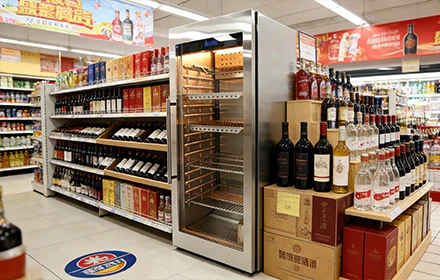
Why Humidity Is the Hidden Cost Driver in Refrigeration
In commercial refrigeration, most buyers focus on compressor efficiency, refrigerant type (e.g., R290), or cabinet design. However, humidity control is often the most overlooked factor directly affecting energy consumption and product visibility.
High indoor relative humidity (RH) increases:
- Latent heat load on evaporators
- Frost formation on coils
- Glass door condensation
- Compressor runtime and energy cost
In short:
Higher humidity = higher refrigeration load = higher energy bills
For supermarkets, convenience stores, and chain retailers, poor humidity control can increase refrigeration energy consumption by 10–30%.
How Humidity Impacts Display Case Performance
1. Condensation on Glass Doors
When warm, humid air contacts a cold glass surface:
- Water vapor condenses → foggy doors
- Reduces product visibility → lower sales conversion
- Leads to customer complaints
Typical scenarios:
- Beverage coolers in humid climates
- Glass door freezers near store entrances
2. Increased Refrigeration Load
Humidity introduces latent heat, which is more energy-intensive to remove than sensible heat.
Effects include:
- Longer compressor cycles
- Higher electricity consumption
- Reduced system efficiency (COP drop)
3. Frost & Ice Build-Up
High humidity accelerates:
- Ice formation on evaporator coils
- Blocked airflow
- More frequent defrost cycles
Result:
- Temperature instability
- Product quality risks
The Core Logic: Humidity → Load → Energy Cost
Here’s the engineering relationship simplified:
- High RH → More moisture in air
- Moisture enters cabinet → Condenses/freezes
- System removes latent heat → Increased load
- Compressor runs longer → Higher kWh usage
This is why humidity control is not just comfort—it’s an energy strategy.
Optimal Store Humidity for Display Cases
For most commercial refrigeration environments:
- Recommended store RH: 45% – 55%
- Critical threshold: >60% RH → condensation risk increases sharply
Different applications:
| Application | Recommended RH |
|---|---|
| Supermarkets | 45–55% |
| Convenience stores | 40–50% |
| Cold chain retail (frozen focus) | ≤45% |
Anti-Condensation Strategies (Layered Approach)
1. HVAC Integration (Most Critical)
Humidity control must start with the HVAC system—not the cabinet.
Key actions:
- Install dedicated dehumidification control
- Use DOAS (Dedicated Outdoor Air System) for fresh air
- Maintain stable indoor RH before it reaches display cases
Best practice:
Treat humidity at the building level, not just the equipment level.
2. Airflow & Store Layout Optimization
Poor airflow leads to localized humidity pockets.
Optimize:
- Avoid placing display cases near entrances
- Reduce exposure to outdoor air infiltration
- Maintain proper aisle spacing for airflow circulation
3. Anti-Condensation Glass & Door Heating
For glass door merchandisers:
- Use Low-E anti-condensation glass
- Apply frame heaters or glass heaters (controlled, not always-on)
Benefit:
- Prevent fogging without excessive energy waste
4. Night Curtains & After-Hours Strategy
For open multideck chillers:
- Install night curtains (night blinds)
- Reduce moisture infiltration during closed hours
Energy savings:
- Typically 10–22% reduction in energy use
5. Defrost Strategy Optimization
High humidity requires smarter defrost logic:
- Demand-based defrost instead of timed
- Reduce unnecessary heat load from excessive defrost cycles
6. Door Sealing & Infiltration Control
Even small leaks introduce humid air.
Check:
- Door gaskets
- Alignment issues
- Frequent opening zones
Simple test:
- “Dollar bill test” for seal integrity
HVAC + Refrigeration: Integrated Solution Model
The most efficient supermarkets treat HVAC and refrigeration as a single system.
Integrated Approach:
- HVAC controls indoor RH (macro level)
- Refrigeration handles product cooling (micro level)
- Sensors coordinate load balancing
Example System Strategy
- HVAC maintains 50% RH
- Display cases use:
- Low-E glass
- Efficient evaporators
- Smart controllers reduce compressor runtime
Result:
- Lower fogging
- Stable temperature
- Reduced energy cost
ROI: Why Humidity Control Pays Off
Investing in humidity control delivers measurable returns:
Direct Savings
- Reduced compressor runtime
- Lower electricity bills
- Less defrost energy consumption
Indirect Gains
- Better product visibility → higher sales
- Reduced maintenance costs
- Longer equipment lifespan
Typical ROI timeline:
- 1–3 years depending on store size and climate
Common Mistakes to Avoid
- Treating condensation as a cabinet problem only
- Ignoring HVAC humidity control
- Using constant door heaters (wasting energy)
- Overlooking store layout and airflow
Final Takeaway
Humidity control is not optional—it is a core performance driver in commercial refrigeration.
If you want to reduce energy costs and eliminate condensation, you must connect:
Store humidity → refrigeration load → system energy consumption
The most effective strategy is always:
HVAC + Display Case + Operational Design working together