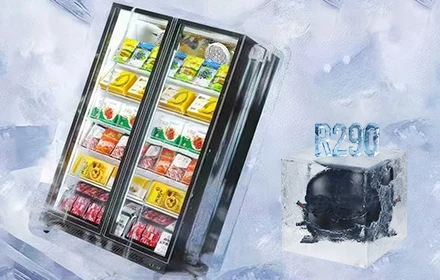
If your glass door display freezer is not reaching -18°C (0°F), it’s more than a minor inconvenience—it directly impacts food safety, product shelf life, and energy costs.
In commercial environments like supermarkets, convenience stores, and cold chain retail, even a 2–5°C deviation can lead to shrink, compliance risks, and customer complaints.
This guide breaks down the most common causes, organized by symptom → root cause → priority fix, so your team can act fast.
1. Quick Diagnosis: What Symptoms Are You Seeing?
Before diving into technical checks, identify the main symptom:
| Symptom | Likely Issue |
|---|---|
| Compressor runs constantly | Refrigerant loss / airflow issue |
| Temperature fluctuates | Door leakage / defrost failure |
| Evaporator icing up | Airflow blockage / defrost problem |
| Interior warm but fan running | Cooling system inefficiency |
| Only top shelves warm | Air curtain / airflow imbalance |
Rule of thumb:
If the unit runs non-stop but doesn’t cool, it’s usually a capacity issue, not a control issue.
2. Most Common Causes (Ranked by Priority)
2.1 Door Seal Leak (Highest Probability)
Why it matters:
A damaged or loose gasket allows warm air infiltration, forcing the freezer to overwork.
Signs:
- Frost buildup near door edges
- Condensation on glass
- Door not closing tightly
Fix:
- Replace gasket (low cost, high ROI)
- Check door alignment and hinges
Priority: HIGH (check this first)
2.2 Airflow Blockage (Very Common in Retail Use)
Why it matters:
Display freezers rely on forced air circulation. Blocked vents = uneven cooling.
Signs:
- Top shelves warm, bottom cold
- Ice near evaporator
- Fans running but weak cooling
Fix:
- Keep clearance between products and vents
- Reorganize shelf layout
- Train store staff on loading limits
Priority: HIGH
2.3 Refrigerant Leak or Low Charge
Why it matters:
Low refrigerant = insufficient cooling capacity.
Signs:
- Compressor running continuously
- Temperature stuck above -10°C to -5°C
- Oil stains near piping
- Weak frost pattern on evaporator
Fix:
- Leak detection + repair
- Recharge refrigerant (licensed technician required)
Priority: CRITICAL (requires technician)
2.4 Defrost System Failure
Why it matters:
If defrost fails, ice blocks airflow and heat exchange.
Signs:
- Heavy ice on evaporator
- Fan noise but no airflow
- Temperature gradually rising
Fix:
- Check defrost heater
- Inspect timer or control board
- Manual defrost as temporary solution
Priority: HIGH (before compressor damage)
2.5 Ambient Temperature Too High
Why it matters:
Most display freezers are rated for ≤25°C / 77°F ambient.
Signs:
- Unit struggles during daytime
- Better cooling at night
- Installed near ovens or sunlight
Fix:
- Improve store ventilation
- Relocate unit
- Use higher climate-class models
👉 Priority: MEDIUM
2.6 Condenser Dirty or Blocked
Why it matters:
Dirty condenser = poor heat rejection → reduced cooling efficiency.
Signs:
- Compressor overheating
- High energy consumption
- Dust buildup on condenser
Fix:
- Clean condenser coils regularly
- Ensure proper ventilation clearance
Priority: MEDIUM (routine maintenance)
3. Troubleshooting Workflow (Step-by-Step)
For operations teams, follow this sequence:
Step 1 – External Check (No tools)
- Door seal condition
- Product blocking airflow
- Ambient temperature
Step 2 – Basic Maintenance
- Clean condenser
- Check fan operation
Step 3 – Internal Inspection
- Ice buildup on evaporator
- Defrost cycle function
Step 4 – Technical Diagnosis
- Refrigerant level
- Compressor performance
Key Insight:
80% of “not cold enough” issues are solved in Step 1–2, without technicians.
4. When to Call a Technician
Call a professional if:
- Compressor runs continuously for 24+ hours
- Temperature cannot go below -10°C
- You suspect refrigerant leakage
- Electrical components (defrost, sensors) fail
Ignoring these can lead to:
- Compressor burnout
- Inventory loss
- System replacement costs
5. Prevention: How to Keep Freezers at -18°C
For B2B buyers and store operators:
- Use auto-closing doors + high-quality gaskets
- Train staff on correct loading practices
- Schedule monthly condenser cleaning
- Choose models with stable airflow design
- Monitor temperature with alerts
6. Final Takeaway
If your display freezer is not cold enough, don’t immediately assume a major failure.
Start with:
- Door seal
- Airflow
- Maintenance
Only then move to:
4. Refrigerant
5. System diagnostics
This structured approach reduces downtime, protects inventory, and avoids unnecessary repair costs.