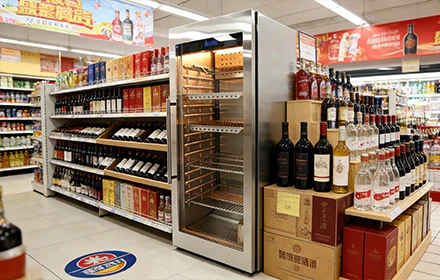
Introduction: Why Cooler Wall Design Drives Beverage Sales
In modern retail environments, especially convenience stores and supermarkets, the beverage cooler wall is one of the highest revenue-generating zones.
A well-designed cooler wall can:
- Increase impulse purchases by 20%–40%
- Improve SKU visibility and turnover rate
- Reduce restocking frequency and labor cost
This guide breaks down a practical 3-step framework based on:
- Linear feet (space planning)
- Door count (capacity planning)
- Planogram (SKU arrangement)
Step 1: Plan Your Cooler Wall by Linear Feet
What is Linear Feet in Cooler Wall Design?
Linear feet refers to the total horizontal length of your refrigeration wall.
It determines:
- Total display capacity
- Number of doors
- SKU depth and variety
Standard Cooler Wall Sizes (North America)
| Store Type | Recommended Linear Feet | Typical Setup |
|---|---|---|
| Small Convenience Store | 6–12 ft | 1–2 doors |
| Medium Store | 12–24 ft | 2–4 doors |
| Large Store / Gas Station | 24–40 ft | 4–8 doors |
| Supermarket | 40+ ft | Multi-section wall |
Pro Tip
For project buyers, always align linear feet with:
- Daily foot traffic
- Beverage category mix (soft drinks, energy drinks, dairy, water)
- Peak-hour demand
Rule of thumb:
1 glass door ≈ 3 linear feet
Step 2: Calculate Door Count for Maximum Sales Density
Why Door Count Matters
Door count directly impacts:
- Product capacity
- Customer browsing behavior
- Energy consumption
Common Configurations
| Door Type | Best For | Capacity Level |
|---|---|---|
| Single Door | Small stores | Low |
| Double Door | Medium stores | Medium |
| Triple Door | High-traffic stores | High |
| Multi-door lineup | Chain retail | Maximum |
B2B Selection Logic
- 2 doors → startups / small operators
- 3 doors → standard convenience store
- 4–6 doors → gas station chains / supermarkets
- Custom lineup → franchise rollout projects
For North America, triple door merchandisers are the most balanced choice.
Step 3: Build a High-Converting Planogram
What is a Planogram?
A planogram defines how products are arranged inside the cooler to maximize visibility and sales.
Core Planogram Strategy
1. Eye-Level = Best Sellers
- Energy drinks
- Coca-Cola / Pepsi
- High-margin SKUs
2. Top Shelf = Premium Products
- Functional beverages
- Imported drinks
3. Middle Shelf = Core Volume Products
- Soda
- Bottled tea
4. Bottom Shelf = Bulk / Low Margin
- Water
- Large-size bottles
SKU Allocation Formula
Use this structure:
- 40% → Fast-moving SKUs
- 30% → Core products
- 20% → New / promotional items
- 10% → Seasonal or experimental
Step 4: Layout Optimization for Real Stores
Recommended Cooler Wall Layout
Best placement strategies:
- Near store entrance → impulse boost
- Opposite checkout → last-minute purchases
- Along main traffic flow → maximum exposure
Step 5: Operational Efficiency Considerations
For B2B buyers, layout is not just about sales—it’s about operations.
Key Factors:
- Restocking path efficiency
- Door opening direction
- Energy-saving night curtains
- LED lighting visibility
Step 6: Common Mistakes to Avoid
❌ Too many SKUs → decision fatigue
❌ Poor category grouping → confusion
❌ Underestimating door count → lost sales
❌ Ignoring restocking logistics
Conclusion: A Scalable Framework for Beverage Cooler Wall Design
To summarize:
- Linear feet defines your total capacity
- Door count defines your operational scale
- Planogram defines your sales performance
If you combine these three elements correctly, your cooler wall becomes a high-efficiency sales machine, not just a storage unit.
FAQ (Highly Converting Section)
Q1: What is the best cooler wall size for a convenience store?
Most stores use 2–4 glass doors (6–12 ft) depending on traffic.
Q2: Are triple door beverage coolers worth it?
Yes. They provide the best balance between:
- Capacity
- Energy efficiency
- ROI
Q3: How often should I update a planogram?
Every 4–8 weeks based on sales data.
Looking for a Custom Beverage Cooler Wall Solution?
If you’re sourcing for:
- Chain stores
- Supermarkets
- Wholesale distribution
We provide:
- Custom door configurations
- OEM branding
- Project-based layout support