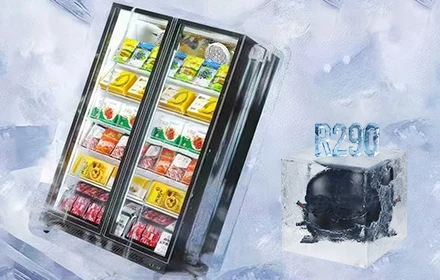
Why Frost Build-Up Is a Serious Problem
Excessive frost isn’t just a cosmetic issue—it directly impacts:
- Energy consumption (up to +20–40%)
- Cooling efficiency
- Product temperature stability
- Compressor lifespan
For B2B buyers (supermarkets, chains, cold storage), frost issues quickly turn into operational cost + maintenance risk.
How Frost Forms (Core Mechanism)
Frost is caused by moist air entering the cabinet, then freezing on cold surfaces.
Key variables:
- Warm air infiltration
- Humidity level
- Surface temperature (<0°C / 32°F)
Root Cause Framework (Systematic Diagnosis)
Instead of random troubleshooting, use this structured model:
1. Door Seal Issues (Most Common Cause)
Symptoms:
- Frost near door edges
- Ice buildup at front shelves
- Compressor runs more frequently
Diagnosis:
- Close door on a piece of paper → pull test
- Check for cracks, deformation, dirt
Fix:
- Clean gasket (warm water + mild detergent)
- Replace damaged seals
- Adjust hinges/alignment
B2B Insight: Poor door sealing can increase energy cost by 10–25% per unit/year.
2. High Ambient Humidity (Hidden Killer)
Symptoms:
- Uniform frost across evaporator
- Faster ice accumulation during peak hours
- More severe in summer / coastal areas
Causes:
- Store humidity > 60% RH
- Entrance doors frequently opening
- HVAC imbalance
Fix:
- Improve air conditioning / dehumidification
- Install air curtains at entrances
- Use night curtains after hours
Open display chillers are especially sensitive to humidity.
3. Defrost System Failure (Critical Fault)
Symptoms:
- Thick ice on evaporator coil
- Airflow blocked → temperature rises
- Unit struggles to reach setpoint
Key Components:
- Defrost heater
- Defrost thermostat
- Defrost timer / controller
Typical Failure Signs:
- Heater not warming during cycle
- Ice never fully melts
- Frost keeps accumulating cycle after cycle
Fix:
- Test heater continuity
- Replace faulty thermostat
- Check controller settings
If not fixed: airflow blockage → compressor overload → system failure.
4. Frequent Door Openings (Operational Issue)
Symptoms:
- Frost increases during busy hours
- Ice near air outlet or fan area
- Temperature fluctuations
Causes:
- High customer traffic
- Staff leaving doors open
- No door alarm system
Fix:
- Install door open alarm
- Train staff (close within 5–10 seconds)
- Use self-closing hinges
In retail environments, this is often the #1 operational cause.
Quick Diagnosis Table (For Engineers & Buyers)
| Symptom | Likely Cause | Priority |
|---|---|---|
| Frost near door | Door seal leak | High |
| Frost everywhere | High humidity | Medium |
| Ice on evaporator | Defrost failure | Critical |
| Frost after peak hours | Door opening frequency | Medium |
Step-by-Step Troubleshooting Process
Use this sequence to avoid misdiagnosis:
Step 1 — Check Door Seal
→ 70% of cases solved here
Step 2 — Evaluate Store Environment
→ humidity, airflow, entrance exposure
Step 3 — Inspect Defrost System
→ heater + timer + thermostat
Step 4 — Review Usage Pattern
→ traffic, staff behavior
Prevention Strategies (High-Value for B2B Sales)
1. Upgrade to Better Door Systems
- Magnetic gaskets
- Double-layer sealing
- Heated door frames (anti-condensation)
2. Add Night Curtains (Open Cases)
- Reduce moisture entry after hours
- Save 10–22% energy
3. Smart Defrost Control
- Adaptive defrost (on-demand)
- Avoid over/under defrosting
4. Store-Level Climate Control
- Keep RH < 55%
- Balance HVAC with refrigeration load
Cost Impact of Ignoring Frost
If frost is not addressed:
- Energy cost ↑ 20–40%
- Cooling efficiency ↓
- Maintenance frequency ↑
- Equipment lifespan ↓
For a supermarket with 20 units:
This can mean $10,000+ extra annual electricity cost.
FAQ (SEO Optimization)
Q1: Why does my freezer keep frosting up quickly?
Usually due to door seal leaks, high humidity, or defrost system failure.
Q2: Is frost normal in commercial freezers?
Light frost is normal, but thick ice buildup indicates a problem.
Q3: How often should a freezer defrost?
Typically 2–4 times per day, depending on usage and environment.
Q4: Can humidity alone cause frost buildup?
Yes—especially in open display or high-traffic retail environments.
Final Takeaway
Frost buildup is not a single issue—it’s a system interaction problem involving:
- Door sealing
- Humidity control
- Defrost performance
- Usage behavior
When you diagnose it systematically, you don’t just fix the issue—you reduce long-term operating cost and improve system reliability.