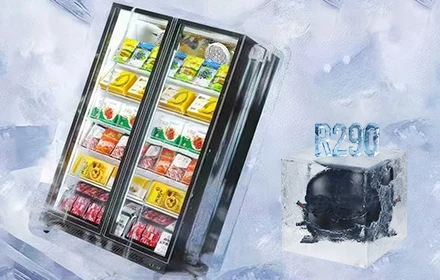
Introduction: The Hidden Risk in Refrigeration Investments
For commercial refrigeration buyers in Europe, the biggest risk is no longer equipment failure—it’s regulatory obsolescence.
Under the evolving EU F-gas framework, refrigeration systems using high-GWP refrigerants risk becoming “stranded assets”—equipment that is still functional but no longer compliant, serviceable, or economically viable.
If you’re sourcing:
- Multideck open chillers
- Beverage coolers
- Island freezers
- Glass door merchandisers
then understanding the trajectory of the EU F‑gas Regulation is critical to protecting your investment.
1. What Are “Stranded Refrigeration Assets”?
A stranded asset in refrigeration refers to equipment that:
- Cannot be legally operated under new regulations
- Becomes too expensive to maintain (due to refrigerant costs)
- Requires premature replacement or retrofit
Typical Triggers in the EU Market
- High-GWP refrigerant bans (e.g., R404A restrictions)
- Tightening CO₂-equivalent quotas
- Limited availability of replacement refrigerants
- Rising leak repair and servicing costs
👉 In short: your system may still work—but the market won’t support it anymore.
2. EU F-Gas Trends: Where the Market Is Heading
Key Policy Direction
The EU is accelerating its transition toward low-GWP and natural refrigerants, including:
- R290 (propane)
- CO₂ (R744 systems)
- Other ultra-low GWP alternatives
What’s Changing in Practice
- Progressive phase-down of HFC quotas
- Expansion of GWP-based bans by application
- Increased compliance requirements for servicing and leakage control
High-GWP Refrigerants Under Pressure
Common refrigerants at risk:
- R404A (GWP ~3922)
- R134a (GWP ~1430)
These are increasingly:
- Expensive
- Restricted
- Operationally risky
The market is shifting toward “future-proof refrigeration”—systems that remain compliant for 10–15 years.
3. The Real Cost of Getting It Wrong
Choosing the wrong refrigerant today can create multi-layer financial exposure:
1. Retrofit Costs
- System redesign or compressor replacement
- Refrigerant conversion challenges
2. Maintenance Inflation
- Rising cost of high-GWP refrigerants
- Limited technician availability
3. Downtime & Product Loss
- Equipment failures due to non-compliant systems
- Business interruption in retail environments
4. Accelerated Depreciation
- Equipment lifespan shortened by regulation—not engineering
Result: ROI assumptions collapse long before the equipment reaches end-of-life.
4. What “Future-Proof Refrigeration” Actually Means
Future-proofing is not a marketing term—it’s a procurement strategy.
A future-proof refrigeration system should:
- Use low-GWP refrigerants (<150 or near-zero)
- Align with long-term EU compliance pathways
- Minimize retrofit risk over a 10+ year lifecycle
- Maintain stable operating costs
Typical Future-Proof Options
| Refrigerant | GWP | Status |
|---|---|---|
| R290 (propane) | ~3 | Highly future-proof |
| CO₂ (R744) | 1 | Widely adopted in large systems |
| HFO blends | <150 | Transitional (case-dependent) |
For plug-in merchandisers, R290 is currently one of the most practical solutions.
5. Procurement Checklist: Avoiding Stranded Assets
Use this buyer-side checklist when sourcing commercial refrigeration:
A. Refrigerant Strategy
- Is the refrigerant GWP <150 (preferably <10)?
- Is it aligned with EU long-term policy direction?
B. Lifecycle Cost
- What is the total cost of ownership (TCO) over 10 years?
- Are refrigerant prices stable or volatile?
C. Compliance Horizon
- Will the system remain compliant beyond 2030?
- Are there known upcoming restrictions for this refrigerant?
D. Serviceability
- Are trained technicians widely available?
- Is spare parts support secure long-term?
E. Supplier Capability
- Does the supplier have proven low-GWP system experience?
- Can they support multi-store rollout or project deployment?
This checklist ensures you’re buying an asset—not a liability.
6. Strategic Insight: Why Timing Matters
Many buyers delay upgrading due to upfront cost concerns.
However:
- Early adopters benefit from stable pricing and incentives
- Late adopters face supply constraints and higher costs
- Regulatory pressure tends to accelerate—not slow down
The optimal window is before restrictions force your decision.
Conclusion: Build Compliance Into Your ROI Model
EU F-gas trends are not just environmental policy—they are market-shaping forces.
To avoid stranded refrigeration assets:
- Prioritize low-GWP systems (R290 / CO₂)
- Evaluate regulatory risk alongside cost and performance
- Use a future-proof procurement framework